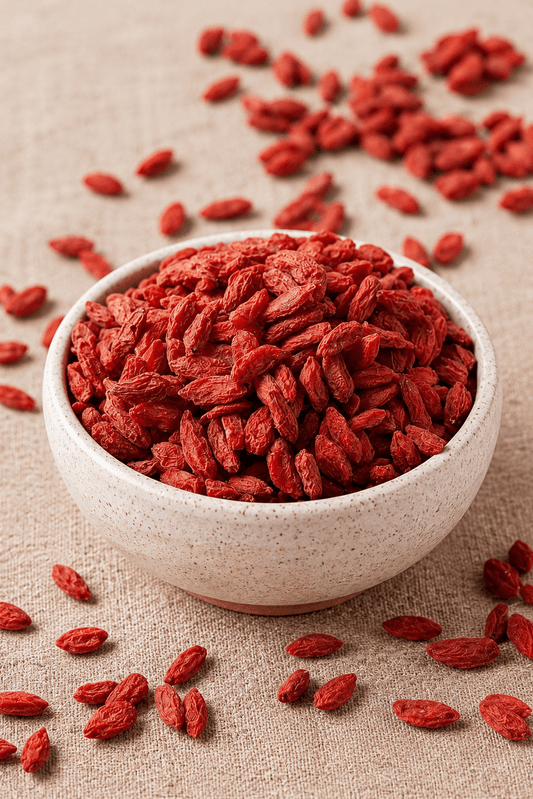
Organic dried goji berries, 125 g — soft, chewy, sweet with a tart edge, from the Mongolian Plateau in northern China. Also called wolfberries.
One thing to read before buying
If you take warfarin, do not eat goji berries regularly without telling your anticoagulation clinic.
This is not a theoretical caution. There are published case reports of people on stable warfarin whose INR rose sharply — in some cases with bleeding — after they began drinking goji juice or tea, and whose INR settled again when they stopped. The mechanism appears to involve goji inhibiting the enzyme that clears warfarin from the body. Whatever the mechanism, the pattern has been reported often enough to be taken seriously, and it is almost never mentioned on a packet.
The same caution applies more mildly if you take medication for diabetes or for blood pressure, since goji has been reported to add to their effect. And goji is a member of the nightshade family (Solanaceae), alongside tomato, potato, pepper and aubergine — relevant if you avoid nightshades or are allergic to them.
For everyone else, they are simply a dried fruit and a very good one.
What they are
The fruit of Lycium barbarum, a thorny shrub of the nightshade family grown across northern China, particularly Ningxia. They have been used in Chinese cooking and medicine for well over a thousand years — in soups, congee, teas and broths far more often than eaten by the handful, which is a Western habit.
They are picked and dried carefully rather than sun-baked, which is why good goji stay soft and pliable rather than going hard. A bag of hard, dark, brittle berries has been badly dried or badly stored.
What they taste like
Not like a raisin, and this surprises people. There is real sweetness, but underneath it a distinct tartness and a faintly savoury, almost tomato-like note — unsurprising, given the family. That savoury edge is exactly why they work in Chinese broths and stews, and why they are more interesting than a sweeter dried fruit.
Using them
-
By the handful, straight from the bag.
-
Scattered over porridge, granola, yoghurt or a breakfast bowl — they soften in the milk.
-
Soaked for ten minutes in warm water, tea or juice, which plumps them and returns them close to the fresh fruit. The soaking liquid is worth keeping.
-
In a broth or a braise — the traditional use. Chicken soup, congee, a pork and vegetable stew: a small handful added towards the end gives sweetness and body.
- In baking, energy balls, trail mix or a rice pilaf, where they behave like a tart currant.
Honest note on the claims
Goji has been marketed harder than almost any other dried fruit, and much of what is said about it is not permitted in Europe. EFSA has authorised no health claim for goji berries. Not for immunity, not for eyesight, not for antioxidants, not for longevity.
What can be said without stretching anything: they are a dried fruit, they contain a useful amount of fibre and carotenoids — zeaxanthin in particular, which is what makes them orange-red — and they contain some vitamin C and iron, though a 125 g bag lasts a long time and a realistic portion is small. Buy them because they are delicious, versatile and unlike anything else in the cupboard.
Storage
Airtight, cool and out of the light. Good goji are soft, and softness means residual moisture, which means they will go hard or eventually mould in a badly closed bag. In a warm kitchen or a Porto summer, keep them in the fridge.




 Dragon Superfoods


