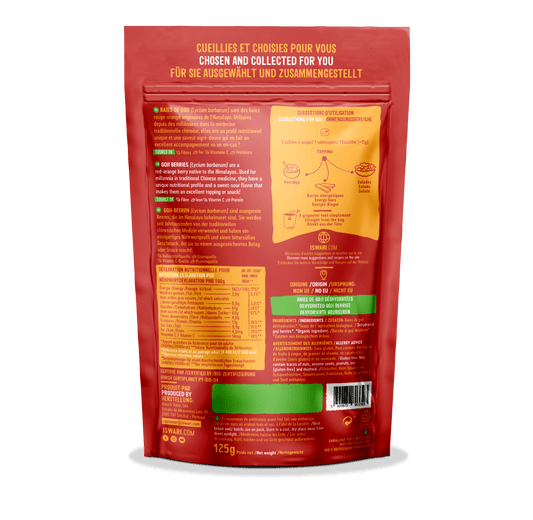
Organic dried goji berries, 100 g, from Dragon Superfoods. Sweet-sour, chewy, and a staple of Chinese cooking and medicine for a very long time before they became a Western health-food fixture.
A small botanical correction worth making. Goji berries sold commercially are almost always Lycium barbarum rather than Lycium chinense, and the two are frequently confused on packaging. Both are nightshades — relatives of tomato, aubergine and potato — which occasionally matters to people who react to that family. In Chinese they are gǒuqǐ, and in traditional cooking they are far more often simmered in soups, congee and broths than eaten as a snack.
One genuine caution, and it is rarely printed anywhere. There are documented case reports of goji berries interacting with warfarin, raising INR and bleeding risk. If you take warfarin or another vitamin K antagonist, speak to your doctor or pharmacist before eating goji regularly. It is a specific, real interaction — not a general caution.
On the “superfood” framing. Goji was one of the most aggressively marketed foods of the 2000s, and much of what was claimed for it does not survive scrutiny: the European Union authorises no health claims for it, and human trials are few and small. It is a nutritious dried fruit with an unusual flavour and a long culinary history. That is enough to justify buying it; the rest was advertising.
How to actually use them. The Chinese way is better than the Western one: a handful thrown into a chicken broth, a soup or a pot of congee, where they soften, plump and release their sweetness into the liquid. Also good soaked in hot water for ten minutes then added to porridge or yoghurt — soaking transforms the texture from leathery to tender. Eaten dry, they are chewy and slightly medicinal.
Available at Só Verde, an organic concept store in Foz, Porto.




 Iswari


