A blend of matcha, cacao and chai spices from Matcha & CO — whisked or shaken with hot milk, and considerably easier to like than plain matcha.
What matcha actually is, since almost every description gets it slightly wrong. It is not simply powdered green tea. The plants are covered and shaded for several weeks before harvest, which starves the leaves of light. They respond by producing more chlorophyll — hence the intense green — and more L-theanine, the amino acid responsible for matcha's savoury, almost broth-like depth. The leaves are then steamed, dried, de-stemmed, and stone-ground into a powder finer than flour. Because you swallow the whole leaf rather than an infusion, matcha delivers more of everything the leaf contains, including caffeine.
An honest note on grades. “Ceremonial grade” has no legal definition and no certifying body — any producer may use the term. In practice it usually indicates first-harvest leaf, stone-ground, intended to be drunk with water alone; “culinary grade” usually means later-harvest leaf with more bitterness, intended for lattes and baking, where milk and sugar carry it. Neither is a standard, and price is a poor guide. For a blend like this one, with cacao and spices, a bright ceremonial-grade matcha would largely be wasted — the accompanying flavours are doing the work.
Never use boiling water. This is the single mistake that makes people think they dislike matcha. Boiling water scalds the powder and pulls out harsh bitterness that no amount of sweetening fixes. Around 70 to 80 °C is right: boil the kettle and let it stand four or five minutes.
And sift it. Matcha clumps — it is ground far finer than flour, and clumps are why home-made matcha so often has bitter lumps in it. A small sieve, or vigorous whisking in a little cool water to make a paste before adding the rest of the liquid, solves it entirely.
Contains caffeine. Cacao adds theobromine alongside it, which is chocolate's gentler stimulant.
Available at Só Verde, an organic concept store in Foz, Porto.


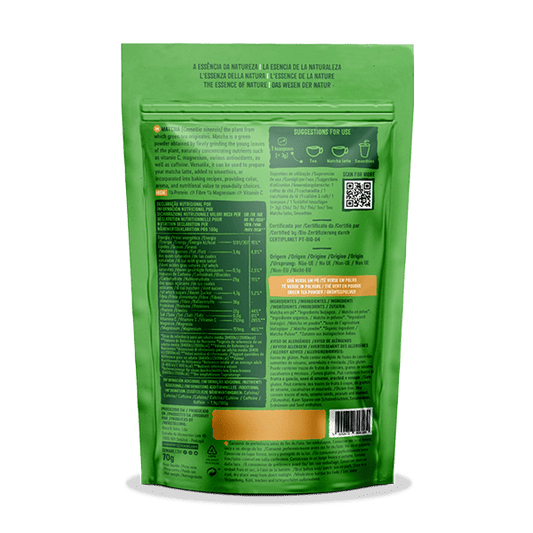


 Matcha & CO
 Piecely Puzzles
 Iswari
 Piecely Puzzles


